| by dick bales |
I think that all of us would agree that shot glass
collecting is still in its relative infancy. On the other hand, people
have been collecting stamps for more than 150 years. This means that
stamp collectors are way ahead of us when it comes to organizing their
collections.
One of the more popular means of collecting stamps is the collecting of
topicals, or the organization of a collection around a specific topic.
Chess, flowers, and animals are just three of an infinite number of
possible categories. Many topical collections have become award-winning
stamp exhibits.
 |
|
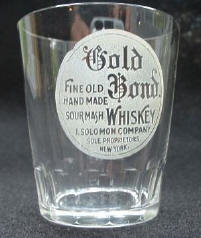
The
Name is "Bond".
Bottled
in Bond. |
|
|
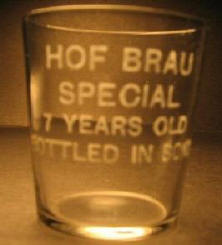
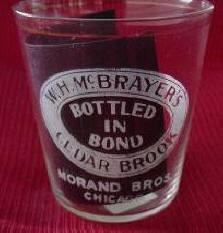
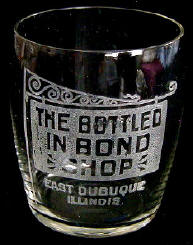
If shot glass collecting were
ever to branch out into topical collecting, then collecting “bottled
in bond” glasses would, I think, be a great subject.
But what is the significance of this term?
|
|
Years ago, whiskey that was sold as
“straight whiskey” might have been anything but real unadulterated
whiskey. For example, it might have been flavored and colored with
iodine and tobacco or vanilla and mint. This became so much of a
problem that a group of reputable whiskey distillers, led by Colonel
Edmund Haynes Taylor, Jr., the creator of Old Taylor Bourbon, joined
with his friend and then Secretary of the Treasury John G. Carlisle to
fight for passage of the Bottled-in-Bond Act of 1897.
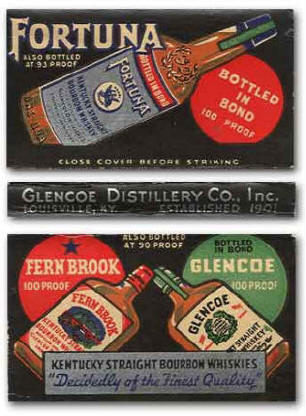
“Bottled in bond” or “bonded” whiskey was (and still is) whiskey that
was produced according to the guidelines set forth in this act. What
were these requirements? The whiskey had to be stored in a federally
bonded warehouse. It had to be legally defined straight whiskey and
distilled in a single season by a single distillery. It had to be
stored in the bonded warehouse for at least four years before
bottling, and then it would have to be bottled at one hundred proof.
The government would certify that this whiskey would be bottled at
this proof; it would also vouch for this aging period. It would do
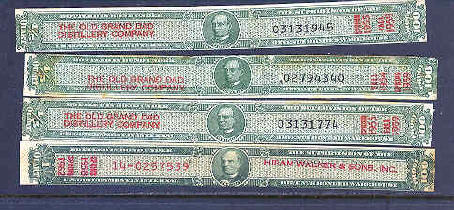
this by sealing the whiskey with the U.S. government’s green strip
stamp. In exchange for meeting all these requirements, the distiller
would qualify for some tax relief--it would not have to pay taxes on
the whiskey until it was bottled and removed from the warehouse for
sale.

Because of these governmental
guarantees, bottled in bond whiskies became very popular in the early
twentieth century. But note that the term “bottled in bond” is not
really a guarantee of quality; rather, it is a reference to the
regulatory procedures under which it was stored, aged, bottled, and
taxed.
|
|
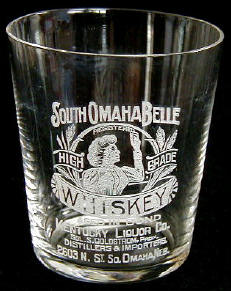
“Bottled in bond” seems to be a term
of art. But there are several glasses that advertise whiskey as being
either “aged in bond,” “in bond,” or something similar. Is this whiskey
identical to “bottled in bond” whiskey, or was the use of words such as
“in bond” merely a clever subterfuge to fool people into thinking that
the whiskey was bottled in bond when it did not quite meet the
governmental standards of the Bottled-in-Bond Act of 1897?
The Code of Federal Regulations, Title 27, Volume 1, Part 5, appears to
answer this question (assuming that a version of this statute was around
in pre-prohibition America). Section 5.42 includes the following under
“Prohibited Practices”:
“The words ‘bond,’ ‘bonded,’ ‘bottled in bond,’ ‘aged in
bond,’ or phrases containing these or synonymous terms, shall not be
used on any label or as part of the brand name of domestic distilled
spirits unless the distilled spirits are: Composed of the same kind of
spirits produced from the same class of materials; produced in the same
distilling season by the same distiller at the same distillery; stored
for at least four years in wooden containers. . . .”
Thus, it appears that these whiskies are bonded whiskies, even though
the magic words, “bottled in bond” are not used.
|
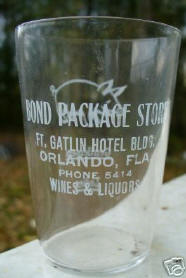
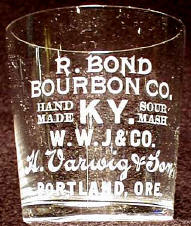
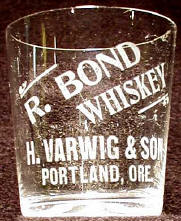
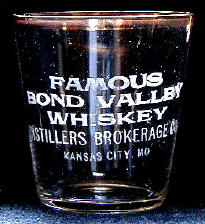
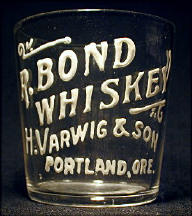
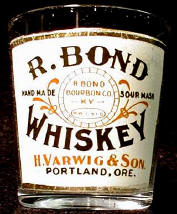
And finally, there are some
glasses that merely use the word “Bond” in the company’s name.
These include, for example, “Bond Valley Whiskey” and “R. Bond
Whiskey.” Because the word “bond” is used in the label, it would
appear that as per the Code of Federal Regulations, these glasses
also represent whiskies that are “bottled in bond.”
|
 |
|
 |
 |
 |
|
 |
 |
 |
Strangely, the word “pure” seems to
be exempt from such strict scrutiny. Section 5.42 of the Code of Federal
Regulations provides that “the word ‘pure’ shall not be stated upon
labels unless: It refers to a particular ingredient used in the
production of the distilled spirits and is a truthful representation
about that ingredient; it is part of the bona fide name of a permittee
or retailer for whom the distilled spirits are bottled; or it is part of
the bona fide name of the permittee who bottled the distilled spirits.”
This means that if James Bond wanted to let his “license to kill” expire
and go into the liquor business, he wouldn’t get rich quick; he would
have to let his whiskey age at least four years and otherwise comply
with federal law. On the other hand, if the singer Prince decided to
change his name again and this time chose the name “Pure,” it appears
that he could water down his whiskey with purple rain, sell it under the
“Princely Pure” label, and never have to worry about getting busted by
the Feds.
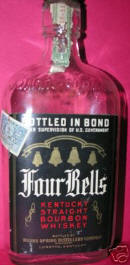
It seems clear that a collection of “bottled in bond” shot glasses,
perhaps augmented with a few similarly labeled pre-prohibition whiskey
bottles and a few green strip stamps, would be an eye-catching exhibit
at any bottle show. It would be fun to try to collect the various
examples of “bond” glasses; even better, you wouldn’t go broke in the
process!
If you would like to comment on "The Common Stuff",
please post it
but you can also
contact Dick Bales directly at BalesD@CTT.com
|